Wednesday, April 6, 2011

Riding DuPont State Forest. Asheville, NC

Snowy April Mountains in Northern NC
Friends from Houghton organize semi-annual road trips to nationally recognized mountain biking sites, usually early spring and late fall when the riding in the Upper Peninsula of Michigan is poor or non-existent.

I've never joined them before - they do some hard core tag-team straight-through driving (often 20 or more hours) to maximize riding and minimize vacation time. I can fall asleep in a car fine, my problem is not being able to stay asleep. I'd be toast. I'm more of a 12 hours-then-a-comfy-bed explorer. This year they chose to explore the South East so that Ann and I could more easily join them from our temporary digs in Central Pennsylvania.
View East from Rental House at Saluda

We planned a few side trips along the way (see my University of Virgina blog entry) and some overnight stops for ourselves, but the ultimate goal was Asheville, North Carolina and environs. The folks from up north found a sweet mountaintop house near Saluda, NC to rent and rounded up 12 likely suspects to share the cost. Great view from the deck for $57 a person, no?

Saluda is a cute little town about 40 minutes south of Asheville, and about 40 minutes east of our ride at Dupont State Forest. Perfect for us, cause while much of the group was bent on riding all day, every day, a couple of us were corrupted by nearby Biltmore mansion (see my Biltmore blog entry) on Saturday. But Sunday it was all Dupont.

Dupont is famous for its waterfalls and exposed granite slick rock. Parts of the 1999 movie, Last of the Mohicans, was filmed here, including the memorable waterfall scenes. So we started out with an all-group ride to the 4 easily accessible falls. Fantastic.


Waterfall Up Close
We'd ride as close as we could, then park the bikes and clamber across the rocks for a closer look. Especially, Bill. Real close. I joined him on the rock at the base of the falls. It was an awe inspiring, moving experience to stand feet from the thundering cascade, your body shaken by the roar, your face washed by the spray, the water leaping and falling past with immense power. A highlight of the whole trip for me.

Really Close
After the falls, we broke up into a long group and a short group. The long group would ride the 30 mile IMBA Epic the encompasses the best riding throughout the forest. The short group would hit some of the highlights closer in, then find other entertainment in town. 

The trails were a mix of dirt road, old two track, and sweet modern single track. On the dirt roads you might find some of the many equestrians out on a beautiful spring day (even some sporting carriages). And plenty of hikers closer in. Further out, we saw almost nobody.

Some of the old two tracks pre-date modern building methods and were severely eroded, providing a nice technical climbing challenge. Sometimes it got to be too much to sustain, turning us into pedestrians walking 25 pound wheeled weights. 
Too Much

The newest single track was ultra nice, giving sweeping, flowing descents that went on and on. Some of the best were Ridgeline Trail, Reasonover Creek, and Airstrip.

There also visited some more remote waterfalls, including Bridal Vail Falls, which you could walk behind. They did this in Last of the Mohicans as the bad guys chased our heros, torches in hand, through the night. Somehow it looked much more spacious in the movie.

The coolest way to get to this falls is from the bottom. There's a long walk up gently sloping granite to the top where a ledge forms the upper falls. Most of the water is in the rapids to the right of the slope, but it has such an even face that much of it is covered with a thin sheen of flowing water, separated by occasional dry patches. My bike shoes were too slick to make much headway, so I went barefoot. Fine on the dry patches, but where there was little flow, algae had accumulated and it was incredibly slick. I began sliding backwards several times and had to spin and drop on my butt to keep from accelerating to the bottom. Eventually I discovered that if I walked where the flow was higher, there was little algae and traction was good. On to the top.
Bill Climbs a Slick Rock Falls

It was quite dramatic to crawl behind the falls on one side and come out the other. Again the feel of the spray and the sound of the powerful flow were awe inspiring. This time we could reach out and touch it. Sitting on the granite next to the falls in the middle of the river was a great place for second lunch. On the way down we discovered a bathtub sized pothole in the bedrock full of water. If had been a bit warmer, I'd have popped in for a soak next to the roaring cascade.

Under Bridal Vail Falls

Riding the slick rock of Cedar Rock Trail was another treat. After an arduous climb up a once-eroded and now armored fall line trail, we arrived at the dome, covered in moss and with sparse trees where soil had built up in cracks. The path was marked by small cairns and was quite steep, but traction was superb. A very unusual environment offering excellent views of the surrounding mountains. The descent was equally steep, and got to be pretty exciting on the eroded lower reaches when we got off bed rock. A very fun trail.

On the trail by 11 am, back at the car by 6 pm, it was a eventful, tiring day. We had time for one more trail - a quick out and back on the buff single track of Ridgeline. We raced to the top, turned around, and raced back down, Bill and Pat in the lead and me bringing up the rear, while Mike and Kathy spotted the Burb in the nearby parking lot for an end-of-day pickup. Good times were had by all.
Mike Ridin' the Slick Rock

Folks had to be back at work on Tuesday, so we headed back to the house, ate a quick supper of leftovers, packed up the cars, and hit the road as the light was failing. We spent the night in Tennessee, the Houghton crew drove on through the night, from 70's and sun to 5 inches of fresh snow back home. We hit 85 F on the way through Virginia. But it was raining and cold back in State College. Spring was over for another few weeks.
The Crew Takes a Break


University of Virgina

The Academical Village and Lawn
Driving down US-81 on our way to Asheville, North Carolina to mountain bike with friends, we made a last minute detour to visit Ann's mom's home town of Waynesboro, Virgina. One thing leads to another of course, and with Charlottesville only 30 miles further, we just had to press on - the University of Virginia's iconic campus tugged at our architectural and  historical selves. Designed by Thomas Jefferson late in life, it is one of his crowning achievements, along with Monticello, the Declaration of Independence, and the Louisiana Purchase. We'd visited Monticello years ago and absolutely loved it, this would complete our exposure to his most famous architecture.

Prime Real Estate
It's a pretty drive down the mountain from Waynesboro to the piedmont and Charlottesville. Entering town, we got the impression one gets at many thriving university towns. Students everywhere, small shops in historic buildings, difficult parking - all the usual aspects. But once parked, we crossed the street and stepped back 200 years.

The core historic campus is immaculately preserved, yet alive. Arranged as ranks of attached student rooms and faculty homes facing across the quad, each in its own style, the high ground is anchored by the Rotunda.

Back Garden Serpentine Wall
Students and faculty still live in the historic rooms, still have wood for their fireplaces stacked outside their doors, and compete for the privilege to stay there. Behind the residences are fantastic gardens with all manner of bulbs, blooming shrubs, and trees. All are surrounded by serpentine brick walls. One of Thomas Jefferson's innovations, they allow a wall to be built on brick thick, making them both stable, economical, and graceful. At the corner of each garden are attractive brick 4 holers - the classiest vault toilets I've had the pleasure to meet.
T.J. in the Rotunda Entry

The Rotunda sits at the north end of the lawn, inspired by and half the scale of the Pantheon. Burned, re-built, then restored in the 1970's to it's original design, it's a gorgeous structure. Interior walls on the entry level inscribe ellipses inside rectangular base forming conference and sitting rooms. Upstairs the former library, with radial shelves around the perimeter under the gallery, rises several stories to the skylit dome overhead. Convocations, doctoral defenses, and tours fill the days of this classic space. 

The Rotunda Upstairs
The historic campus, what Jefferson called his Academical Village, is an institutional treasure of one of our great American universities. And we found upon returning home, of the world. In conjunction with Monticello, it is one of 8 UNESCO World Cultural Heritage sites in the U.S. How many schools can claim that?


Friday, April 1, 2011

Elton Comes to Town


The Surprise Tickets
Elton came to town. Sir John, that is. We were in Huntingdon Sunday afternoon getting in an early season mountain bike ride through the hills overlooking Raystown Lake, when Ann got a call from Renee - free tickets to Elton John at the Bryce-Jordan arena back in State College if we could get home and ready in the next 2 hours.

Now I've never been a big fan of arena concerts (not even 30 years ago seeing Genesis at the Cleveland Colliseum - my last such event), and though I like some of John's songs, he's never been top of my list. But what an opportunity to try something we haven't done in decades. To join the crowds in town and see a Pop Icon, one of the most popular and successful male singer/songwriters of all time, in his natural environment - the arena. A can't miss event.

Ann Approaches Bryce-Jordan
Why he's never been tops with me? Maybe I never got over the 8th grade debate that split my class for my weeks - should John Denver or Elton John get the Grammy? I was in the Denver camp, but Elton got the Grammy. Of  course if you look at my music collection now, John Denver is nowhere to be seen, but I do count an "Elton John's Greatest Hits" among my possessions. In retrospect, I'd say the industry got it right, Elton is the better musician. So letting bygones be bygones, we scarfed a quick supper, and hiked up the hill through campus for an evening of entertainment.

Our tickets were for mid court, about half way up. Unfortunately, it wasn't a basket ball game, so all the action was at the end of the arena. The crowd was good, but not a sell out. The addition of large projection screens since my last arena concert is a big plus - now you can see who that tiny figure under the lights really is. Really this type of concert is more a live light show to music - the people are so small as to be incidental to the entertainment.

Vending Lines at the Concert
But there were lots of the tiny people. John travels with quite a band. A drummer (with the biggest, longest kick drum I've ever seen), a percussionist (with a second full drum kit in addition to the xylophone, bells, triange, etc.), keyboardist, electric bass, electric guitar, John himself on concert grand, and four backup singers. And Leon Russel for the second half of the show on another concert grand, highlighting their new joint album (including a nice song called "Ride that Whale"). Amazingly, the guitarist and drummer had been with Elton on his 1970 tour. All of 'em still making music 40 years later.

Elton John on the Big Screen
As soon as the music started, I remembered why I never liked arena concerts. It's loud, yes, but the real drag is the sound quality. The acoustics of a sports arena are horrific. I'd hoped that 30 years would have lead to some improvements in signal processing to improve the situation (and a well funded artist like this could certainly afford state of the art), but it was not to be. There really was no point in him playing a concert grand - you couldn't tell by the sound. He might as well have been playing an electronic piano. And the kick drum dominated everything - it didn't take long for every song to start sounding like the other.

Elton John has written some very good songs over the years, and I enjoyed hearing them again, but when everything sounds the same and has the same volume level, it detracts from experience for me. I longed for a big reduction in distortion and a greater use of dynamic range. In the end, it's the light show that's changed the most since 1982.

Interestingly, the best live rock concert I've ever been to was also in 1982 - King Crimson live at E. J. Thomas Performing Arts Center at Akron University. This time we're talking concert hall, newly built at the time with careful attention to acoustics. And a band very conscious of musicianship and musicality (this was the first reconstitution of King Crimson with Adrian Belew, Robert Fripp, Tony Levin, and Bill Bruford). Superb playing, attention to dynamic range, and sound quality. I've always wished I could go to that concert again - some of the best live music I've experienced of any style.

Still, the Elton John concert was worth doing as part of our State College experience. To step out of our every day habits and try something new (or something old long since left behind), even if only to confirm our past prejudices still hold.


Wednesday, March 9, 2011

Canaan Valley West Virginia

Cold and Rainy? Hypnocoffee!
While at White Grass cross country skiing, we had the chance to explore the Canaan Valley and the nearby towns of Davis and Thomas. The Canaan Valley sits at 3,000 feet in the mountains of north eastern West Virginia. The surrounding peaks rise to 4,300 feet. Because of its elevation and location, it has a unique cool, wet climate. This gives abundant snow in the winter and damp, mossy summers. The region scores over 150 inches of snow each year, and there are several small downhill resorts in the area in addition to White Grass.

Ann Awaits Her Fix at Hypnocoffee
We stayed at Canaan Valley Resort, a slightly threadbare state park. But rates were excellent and we were able to arrange 4 adjoining rooms set up as suites - every other room having a fold out couch and mini kitchen.

There valley has a few small condo developments, scattered about, but very low key and not expensive. The downtown of Davis is a single street lined with unimpressive older buildings in need of some updating. But a closer look pays dividends. Tucked inside are interesting, often funky local businesses. Hypnocoffee! Nice coffee, fresh baked goods, and Dirt Rag mountain bike magazine in the reading rack. Now you know it's an outdoor town. Great local outfitter and mountain bike store and a quaint little B&B there too.


Griffin Enjoys Dad
Just up the road is Thomas, perched on a steep hillside overlooking the river and the waterfront path on the old rail line. Because of the slope, the two main streets are one sided - all the buildings are uphill from the street. It too has seen better days, with weather beaten siding and peeling paint. Then we happened on the Purple Fiddle Cafe, had a nice snack, and found it a hotbed of local live music. Folk, Celtic, Psychadelic, Blue Grass - every weekend they seemed to have several bands. We came back Sunday night and spent hours with a fine bluegrass band (standing room only), joined a mass exodus to the art gallery next door at intermission showing sculptures from old silver services, hand made buttons and cards, paintings, and a bike sculpture, then back for the second act. Couldn't find a video online of show we saw, but here are some others at the Purple Fiddle.


Griffin Explores the Purple Fiddle
The Purple Fiddle to me exemplifies the area. It carries an air of casual, outdoorsy relaxation with a twist of hillbilly and hippie. The area is the opposite of pretentious. It seems to value its plain, slightly run down appearance, or maybe deems it irrelevant. Inside their old mountain town shells, Thomas and Davis are alive. There are lots of young folk still around, often running new businesses. Skiers, bikers, artists, musicians all hang out together and support each other. Very cool. I find a vacation region that doesn't take itself too seriously, cost too much, but focuses on the fun refreshing.
Ann Hikes Cathedral State Park
Nearby are vast tracts of national forest, including the Dolly Sods, a vast plateau of heath and twisted spruce, Spruce Knob, the highest point in West Virginia at 4,800 feet, and Seneca Rocks, a scenic spine of exposed stone popular with rock climbers. We even had a chance for a quick hike in Cathedral State Park, a section of virgin Hemlock forest. Reminded me of the Upper Penninsula - but with giant rhododendron all about.

All in all, a very cool place. I wish we had time to go back this spring.


Friday, February 25, 2011

Skiing White Grass Touring in West Virginia

Our family had been planning this trip to ski White Grass Touring in the beautiful Cannan Valley of northern West Virginia since we knew we'd be in the East this winter. President's day seemed a safe bet for good snow, and the kids would have Monday off. Unfortunately, the beautiful powder of the week before succumbed to a week of 50 degree weather and rain. We drove south with trepidation.

White Grass is the biggest, best groomed nordic center south of New York - 50 km of groomed trails, snow cat tilling, and 172 inches of snow so far this year. Situated on the slopes of an abandoned downhill venue, they sport some serious elevation, starting at 3,300 feet and rising to 4,300 feet. The old runs are kept clear and parts of the woods are gladed for telemark skiers. An extensive network of service roads and fields provides a route up and down for those inclined to stay on the grooming.

Our fears were realized when we arrived and saw the extensive bare ground at the chalet and throughout the valley. But with the strategic placement of 2 foot tall snow fences, there were a surprising number of narrow, groomed bands of snow through the fields. This day it was partly sunny and near freezing, so what skiing there was might be ok. We each paid our 15 bucks, had a quick training session on the bunny slope for Jennifer and Eric (my sibs), and headed out.

Conditions were highly variable to put it charitably. Tilled granular of the field regularly turned to pure ice where water ran down the hill and across the trail. In the woods, the base thinned and disappeared again and again. We ended up hiking about 1/3 the time, skiing on ice 1/3 the time, and enjoying tilled granular 1/3 the time. If it had been Houghton, we'd have closed the trails. But they doggedly drove their Pisten Bully hundreds of yards across bare dirt to get to groomable snow, often higher up.

Trail difficulty here even in good conditions would be pretty high. With the narrowness and steep hillsides, their trail ratings run a level below what we have at Michigan Tech. Their beginner trails are like our intermediates. Their advanced are as steep as ours, but 10 feet wide instead of 20, and with curves and switchbacks. Think Railroad Ravine and Anaerobic Gulch at Maasto Hiihto in Hancock, but longer. Wahooo! No snow on them this trip, so I only got to walk them.


Amazingly, even with the poor conditions there were over 100 cars in the parking lot. One wonders how many they attract with good conditions. I guess when there's nowhere better, White Grass is where you go. And no one seemed surprised or upset. So I suspect we're spoiled, skiing the Lake Superior snow belt back home, with its reliable snow and colder temperatures. The chalet was rustic-cute, with antique wood stove, low ceilings, cafe, and rental shop. Families were everywhere - they even rented pulks to tow the kiddies.

Near the trailhead, there was a lot of crowding as there were only two 8 foot wide (two way) bands of snow leading to and from higher elevations. Coming down it became an issue - carrying speed, beginners and kids scattered about, dirty patches to dodge. And everyone having a great time. Folks were just great - friendly, helpful, happy to be out skiing.

In the end for us, the weather was pleasant and it was great to be outdoors together with my brother and sister - something we rarely get to do. So it was fun. Despite, not because, of the skiing.


Thursday, February 17, 2011

Morgantown, West Virginia

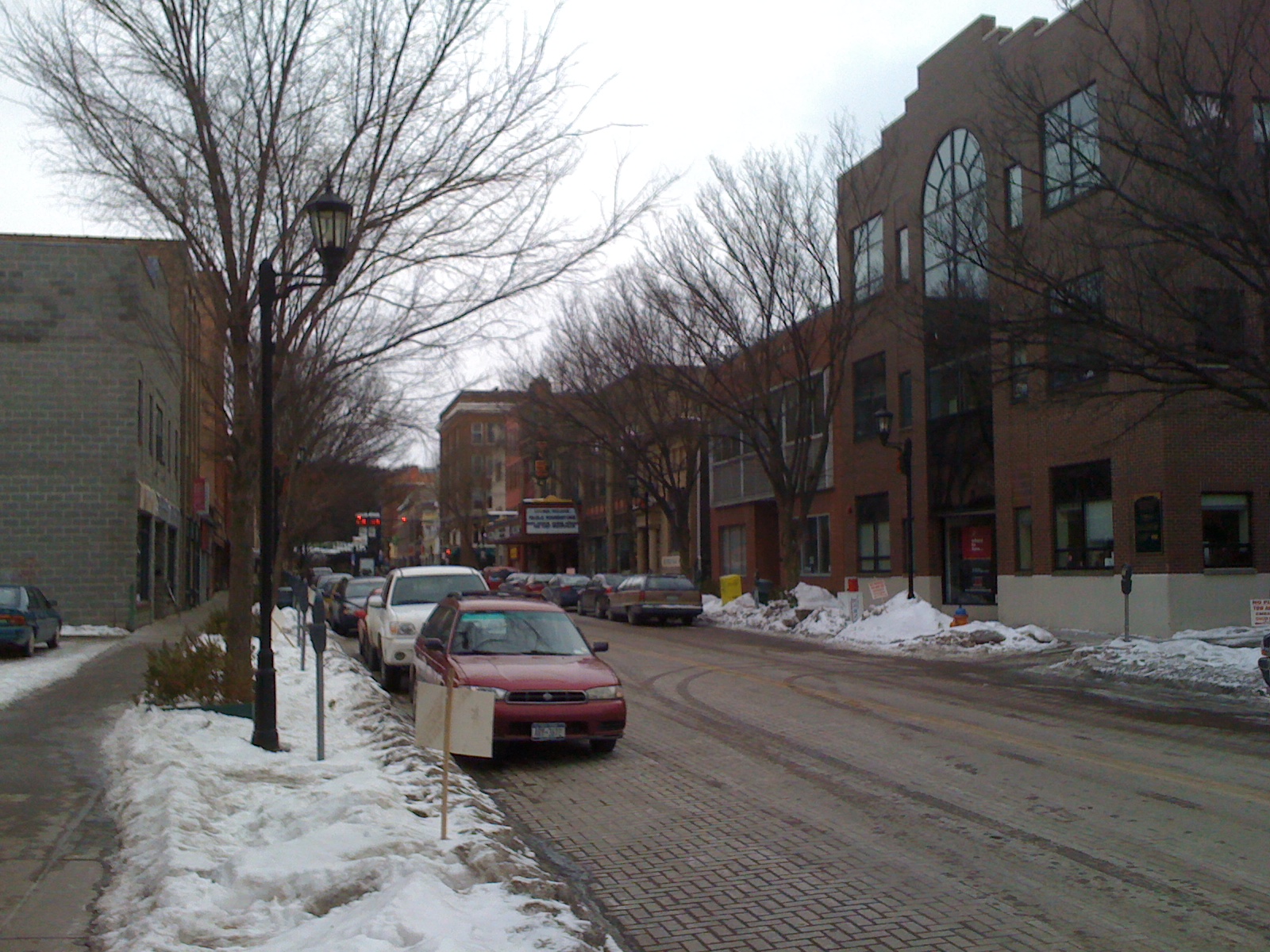
Downtown Morgantown
With Ann in Rhode Island on business (darn if she didn't have a conference at Johnson and Wales University's  museum of cooking - lucky) I decided to take a day trip to visit Morgantown, West Virginia, home of West Virginia University. It's one of the few remaining small college towns within an easy drive of State College that I haven't been to yet, and has a reputation as not only a great college town but also as a great outdoors town. With only 3  months remaining here in for us in central Pennsylvania, the clock was running out on my regional explorations. Sunny weather, a February heat wave, and I was off down I-99 again - my favorite freeway drive here and the one that always seems to lead to scenery and fun.

Seneca Glassworks Shops
Three and a half hours later I completed my scenic traverse of the heart of the Appalachians and dropped out of the Alleghenies into the Monongahela Valley, 70 miles upstream from Pittsburgh. I love that I can drive all that way in mountains with only the small scenic cities of Altoona and Cumberland interrupting the views - an they hardly slow the traffic at all.

I parked just south of downtown on the recently renovated waterfront, right next to the bike path. I was surprised to see several new 10 story office towers, a similar hotel, and a conference center there. Obviously good things are happening in Morgantown. It apparently is one of only 2 metro areas in the state experiencing growth. I can see why. The beautiful setting, the university, the proximity to all manner of outdoors activities, and the short drive to Pittsburgh all make it a great destination.

Waterfront Bike Path on the Mon
Not only are new buildings springing up on the waterfront, they have restored the old Seneca glass factory there too, offering antiques, dining, and bike sales and rentals right on the path. I stopped in at Wamsley Cycles to pick a bike path map and talked to Chip Wamsley, who proved a wonderful store of local information.

Decker's Creek and Bike Path
Turns out there are 10 miles of paved path along the Monongahela River and Decker's Creek, with 23 more of limestone dust extending 19 miles at 2% grade up Decker's Creek and to the Pennsylvania border at Point Marion. And the grade from Point Marion to Connelsville, PA on the Great Allegheny Passage trail from Pittsburgh to DC has recently been purchase and awaits development. What an awesome non-motorized system that will be.

WVU Main Campus
Oh, and the white water folks hit Decker's Creek in spring, plying its Class III to VI rapids. Oh, and the local rowing club actually has a recruiting kiosk on the waterfront inviting folks out to learn crew with the team. Oh, and I saw nearly a dozen mountain bikers and a dozen more road bikers out on a weekday morning riding the trail. There are many mountain bike trails within a 20 minute drive on the ridge and several IMBA epics within a 3 hour drive. And some of the best downhill and cross country skiing in the the mid-Atlantic available within 2 or so hours. Heck there were folks camping in dome tents across the river from the trail (in mid-February). This is a great outdoors town.

The downtown was vibrant, if not as particularly pretty as some similar small cities I've visited recently such as Cumberland.

Engineering Campus PRT station
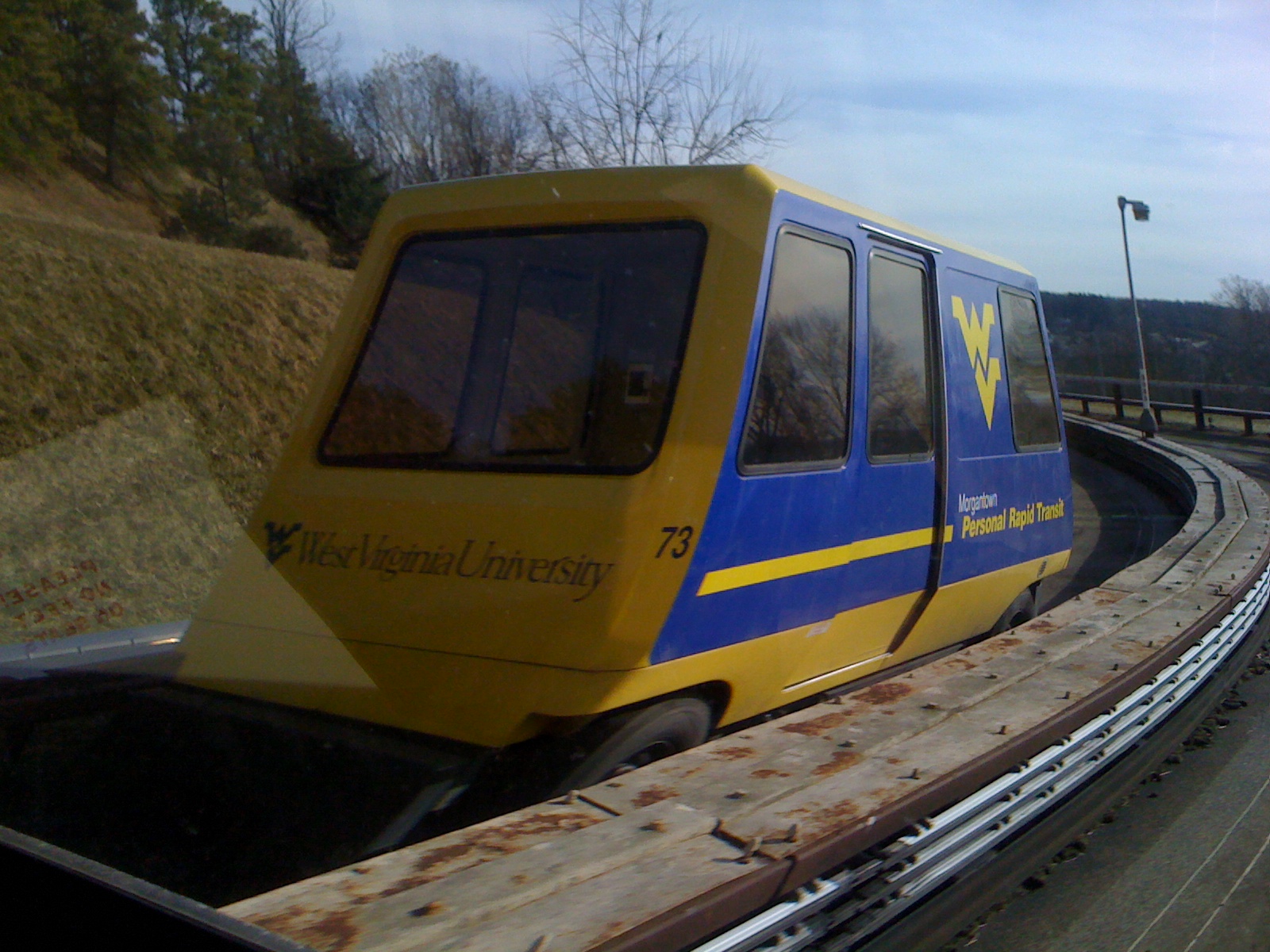
Much of the vibrancy of the town comes from the university. A place with a famously good football team and a strong sports tradition. And a very interesting campus. The main campus is in downtown Morgantown, hemmed in by steep hills. They long ago had to expand to several nearby hill tops. This created a logistical nightmare. So with the help of a federal research funding they build the PRT (Personal Rapid Transit) system. Opened in 1975, it connects downtown, main campus, engineering campus, and medical campus with 5 stops along a concrete and steel elevated track. The uniqueness of it lies in the use of small, electric, rubber tired cars that take you to your chosen destination with no stops.

It's 8.56 miles eventually cost $130 million, because of political pressures for swift implementation and the novelty of the technology, but it definitely works. 94% of its riders are WVU students, and between classes the cars are packed. I found that it's a bit hard for tourists to use though. Cheap at $0.50, I went to the station only to find coin and ID-only turnstiles - and no change machines. So I hiked back up the hill to the library where a librarian kindly made change for me. Not that it mattered in the end - the coin turnstile ate my money and then refused to let me pass. The students were great and swiped me in with their cards. Obviously not a lot of maintenance goes into the coin turnstile. Then you wait a car. They come every few minutes, disgorge their riders, then pull forward, light their sign with the next destination, and take on a new set of riders. These are you mates to your destination - no stops. If it isn't your destination on the sign, wait for the next car, it won't be long. They strive to keep the wait for any destination to under 10 minutes. You press a button indicating where you're headed when you swipe in. I waited maybe 5 minutes for the ride back downtown.
Heating Plant for PRT Tracks

Interestingly, there are steam plants (as well as high voltage substations) all along the route. These generate the heat that melts the snow from the concrete roadway the cars run on, and were one of the big causes of the cost overruns. But they are one of the most attractive steam plants I've encountered.

So the car takes off, no driver, and we head downhill to town at 30 mph. A fairly steep grade and the car's jumping around a rocking back and forth a fair bit - pretty exciting. At intersections there are no switches like in train tracks. That's when you realize these things are steering themselves. No injuries in 35 years with 16,000 average daily riders. And the city credits it with eliminating the gridlock caused by university buses in the 1960's, allowing the fast growth they've experienced since 2000 (at one time the lowest unemployment in the country).

I had a fun time. If I'd known they'd already lost their snow along the river, I'd have brought my bike. A pair of mediocre meals were the only fly in the ointment. Maybe it was bad luck and I missed the best, but I had better luck with dining in Cumberland - a city this reminds me of. Cumberland has a more dramatic setting, lovely historic neighborhoods, the Potomac River, the historic railway, and the Great Allegheny Passage and B&O canal rail trail, and easy access to the mountains, but not the excitement of a college town or the outdoors vibe. Both are great towns, for similar and different reasons. Stop by if you're in the area.


Wednesday, February 16, 2011

Ithaca


View From Cornell Campus
 Last weekend was an opportunity for us to return to a place that we'd enjoyed visiting 20 years ago - Ithaca and Cornell University. Our old friends are long gone from graduate school, but Ann has new friends at Cornell through work, so we headed 3.5 north in search of another cool college town and renewed acquaintances.

Ithaca is situated at the southern end of 40 mile long, 2 mile wide Cayuga Lake in central upstate New York. High hills rise along the sides of the lake and numerous streams cascade through dramatic gorges to the shore. Ithaca sits on the floodplain at the confluence of a number of these streams while Cornell is up the hillside and spans several gorges. It's very pretty.

The Red Room at Vila Madeline
We found a sweet inn on the hillside only 2 blocks from downtown and across a gorge from Cornell. The folks at Inn on Columbia have restored a number of properties in their neighborhood, and have a great design sense. Friday we had the entire Vila Madeline to ourselves - the other 2 rooms were empty. A full kitchen with a scrumptious breakfast of scones was at hand. Fresh fruit and banana bread in a bow wrapped greeting box waited in the fridge - we could have breakfast at our convenience. A stylish sitting room completed our breakfast leisure.

Ann at Viva Taqueria
Ours hosts recommended a number of restaurants. The first night we arrived late, so we dodged into Mercato, newly opened only a few weeks, to share a second dinner. A great find. Superb homemade ravioli, very good sauteed green beans, and a cozy, friendly atmosphere. It was so good we went again the next night, which was also excellent. Ann's snapper in parchment with meyer lemons and blood orange was perfect and imaginative. Pine nut tart was unusual and good for desert. Maybe a close second in our travelling restaurant finds this year.

Downtown Ithaca
We had a nice Mexican lunch at Viva Taqueria on Saturday. Not to the level of Mercato, but worth a visit. Especially unusual was the tequila sampler - a good way to discover any differences in the various levels of tequila. There were interesting restaurants all over Ithaca. We heard it said it has more restaurants per capita than New York city, and we believe it. In fact, Ithaca overall had a kind of relaxed east coast feel to it, partly because of the wide recruiting of Cornell outside the region. Very urban, a bit nerdy, and wildly liberal, like a Berkley for the east. This is the home of the Dali Lama (in fact our neighbors at Vila Madeline Saturday night were in town for a retreat at the monastery), violent student protests in the 60's, the original organic restaurant (the Moosewood), and multiple paraphernalia shops. The winter farmer's market indoors was big - I imagine the outdoor one in summer is massive - overflowing with organic vegetables and baked goods.

Cornell Art Museum Lobby
We spent our afternoon on campus walking the steep hillsides, touring the old arts quad (since 1868 - the youngest of the Ivy League schools), walking the suspension bridge across the gorge, and visiting the I.M. Pei designed art museum. Always eager to experience architecture, we spent several hours exploring the building and its holdings. Of special interest was the exhibit disassembling the Tata, an ultra affordable ($2,200) car being made in India. It was fascinating walking through the components - like moving through a 3D exploded diagram - and reading the challenging trade offs made by the engineers to meet cost, efficiency, cleanliness, and performance goals. Amazing engineering. There was also an inspiring view of the entire Cayuga valley from the 5th floor gallery. As well as some interesting art, including my favorite, a bronze Picasso - head of Ferdinand.

The Tata - Deconstructed
Our last morning we had a leisurely breakfast, then took a drive through the region. We got to see the massive gorges quickly fade into streams through farm and woodland on the hilltops, to follow the waterfront scenic highways along the lake, and to stop at one of the state parks known for its gorge and waterfall for a hike. We walked up the valley floor on a well packed snow covered trail as the walls of the gorge rose higher and higher till we rounded the last bend. The ice flows were dramatic, but even more dramatic was the spray of water that continued to issue from behind the icy curtains and funnels. A fitting last act for a beautiful setting.

Taughannock Falls -Winter
We met with Andrea and Joe at the top local Thai joint where Sunday brunch was being served. But with a difference - it was all you can eat, but they brought the food around on platters straight from the kitchen as soon as it was prepared. No soggy fried dumplings or sopping noodles. Really a great idea, and with a great imagination in preparation. Thanks for the treat, guys! And so from there, tired and full, we headed back on the scenic drive down US15 through the Pennsylvania wilds and home to State College. Mission accomplished.